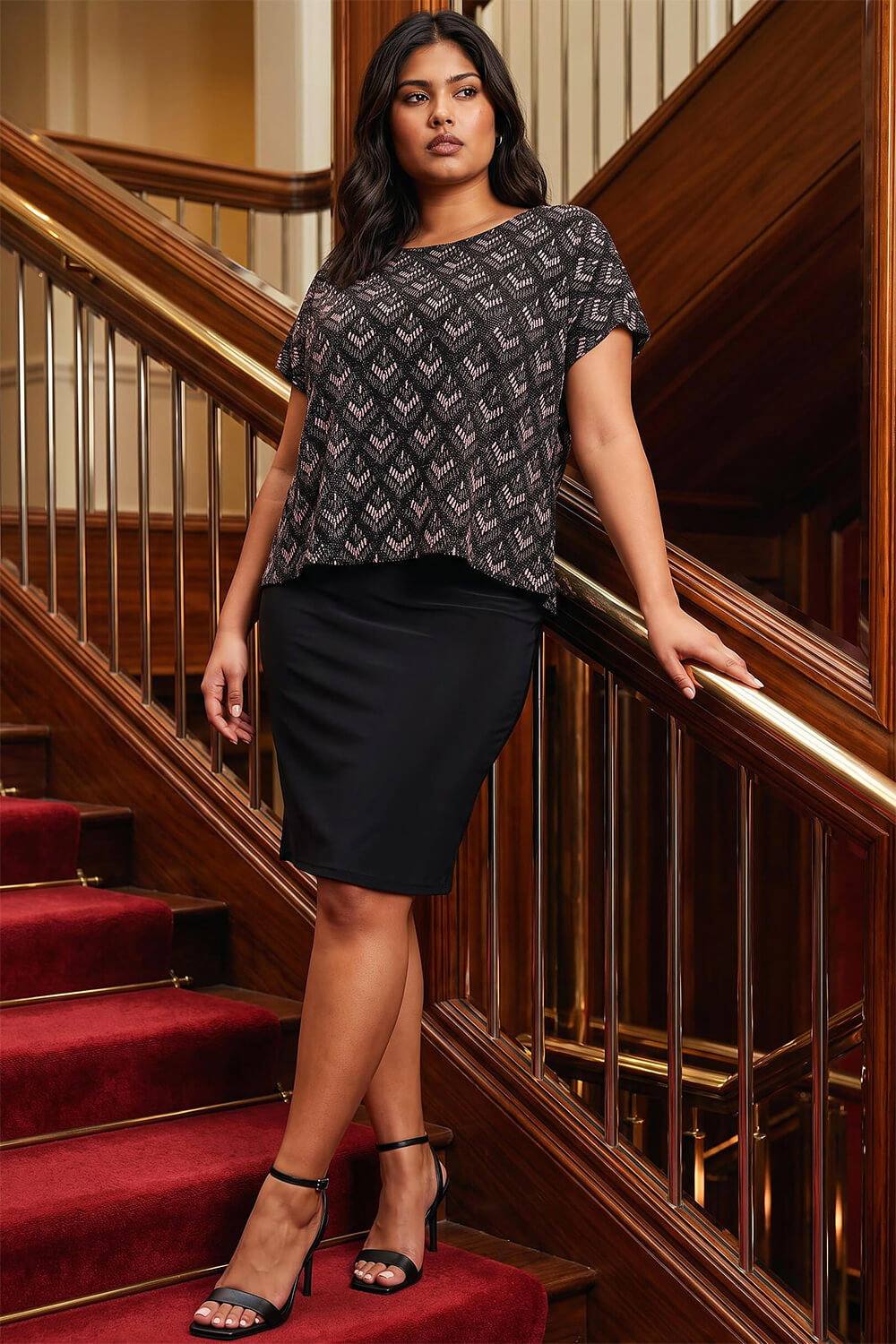
Listed at Dorothy Perkins
Roman Curve Glitter Embellished Contrast Dress In Bronze
£36.00
Listed size label: 30-32
View product detailsSecond-hand shopping is easier when you can separate three questions: will the garment fit, is its condition acceptable to you, and what happens if it is not right? A familiar brand name or size label cannot answer all three.
For online charity-shop listings, including Oxfam, judge the individual item. A useful description and clear measurements matter more than finding a label you have worn before.
Choose a similar garment that already feels good. Lay it flat without pulling it out of shape and note the measurements that affect your comfort. For a blouse, that might include the width across the chest, sleeve length and shoulder-to-hem length. For trousers, add waistband width, inside leg and rise.
Keep the method beside the number. For example, a blouse measuring 52cm across the chest when laid flat is approximately 104cm around at that point. That is a garment measurement, not a statement that it will fit a 104cm bust. The space you prefer, the fabric and the cut still matter.
Do not compare a flat width with a body circumference. If a listing gives a number without explaining where or how it was taken, ask for clarification. Measurements taken while fabric is stretched are different from measurements taken with it relaxed.
Look for photographs of the brand, size, fabric and care labels. An older garment may have a different cut from the brand’s current collection, and the item may have been altered. Check the actual dimensions even when its size is familiar.
Where the description and label disagree, pause before buying. If the garment has no readable size label, the measurements and photographs need to do more work. A guess based on how it looks on a hanger is a weak basis for an order.
Zoom in on the underarms, neckline, cuffs and hem. For trousers, look at the seat, inner thighs, crotch seams and fastening. For knitwear, check for pilling, thinning and small holes. Look at the lining of a dress or jacket as well as the outer fabric.
Decide which issues you can live with. A loose button may be manageable; a damaged zip, missing belt or heavily altered hem may need more work. Ask for another photograph if the listing does not show an area that matters. Do not budget on a stain disappearing in the wash or a repair being simple without evidence.
Read any condition description alongside the pictures. One seller’s condition label should not replace the written account of wear or faults. Save the listing and the description when you order, particularly any measurements or disclosed damage.
For an Oxfam GB order, read the current Oxfam Online Shop returns instructions (Ad). On 3 November 2026, Oxfam stated a 28-day return period for UK items and a £2.95 charge per parcel for change-of-mind or unsuitable-fit returns, deducted from the refund. Faulty or misdescribed goods have separate instructions. Check the policy and order information before buying, and combine eligible returns in one parcel where the instructions allow it.
There is also a distinction between a retailer’s policy and consumer rights. GOV.UK explains that for most online purchases from a business, customers have 14 days after receipt to notify the seller of cancellation, followed by 14 days from that notification to return the goods, subject to exceptions. Buying from a private individual is different. Check the terms for the seller and item you are actually using.
On arrival, inspect the garment and try it on gently before washing, altering or wearing it out. Keep the packaging and order details while you decide. If something appears different from the description, photograph it and contact the seller promptly.
Add delivery, any known alteration costs and the cost of returning an unsuitable item. A lower asking price does not make a piece useful if it needs an expensive adjustment or duplicates something you rarely wear. For an event, leave time to receive and assess it rather than making the purchase depend on an untested repair.
For charity-shop finds, browse the Oxfam Online Shop and check the individual garment measurements and condition. For a wider comparison of clothing, browse the Plus Size Me clothing finder. Confirm the retailer’s current size and availability before planning an outfit around a listing.
Guide checked on 3 November 2026. Follow the seller’s current policy and order instructions for returns; Oxfam policy details were checked on that date; confirm the current terms for your order.
A pair of party trousers can work with a top you already love. A jumpsuit can make an outfit feel complete in one step. The useful question is how each will feel when you sit down, lift your arms and use the bathroom during an evening out.
Before comparing colours or embellishment, choose the shape around those practical needs. This guide focuses on fit checks rather than a list of supposedly perfect buys.
Take out trousers that feel comfortable for several hours. Measure the inside seam from the crotch join to the hem, then note where the waistband sits and how much room you prefer through the thigh. This is a garment comparison, not a replacement for a retailer’s body-size chart.
For a jumpsuit, compare the upper body too: shoulder to waist, the position of the crotch and the room available when seated. A generous leg cannot compensate for a torso that pulls when you raise your arms. If the listing gives no torso or rise measurement, ask the retailer rather than guessing from the model’s height.
A UK label is a starting point. In the charts checked for this guide, Yours lists UK 22 body measurements of 119cm bust, 104cm waist and 128cm hips. ASOS Curve lists UK 22 as 123cm, 105cm and 130.5cm respectively. These are body measurements, not the finished dimensions of a jumpsuit.
Check whether a listing belongs to the retailer’s own label or another brand. Then read its fabric and fit information. Stretch in one panel does not tell you how much movement the lining, waistband or zip will allow. Avoid choosing a smaller size on the assumption that every fabric will relax.
The rise is the distance between the crotch seam and waistband. It affects where trousers sit on your body. The inside leg describes a different part of the garment. If a waistband sits comfortably but the hem is too long, a shorter leg may help; if the crotch pulls or the waistband keeps sliding, shortening the hem will not resolve that fit problem.
Yours distinguishes Petite, Short and Regular: its guide describes 27-inch Petite with proportions adjusted throughout, 29-inch Short retaining the standard fit, and 31-inch Regular. Those labels are specific to its guide; check the individual garment length and intended hem position.
Try trousers with the shoes you expect to wear. Walk, sit and take a step up. Look for a hem you can move in comfortably, rather than planning to hold the legs up all evening.
A back zip may look neat but be difficult to reach alone. A wrap neckline may need checking when seated, while a long tie can need managing in a small bathroom. Practise taking a jumpsuit on and off before deciding to keep it. Check that fastenings open far enough without forcing the seams.
With trousers, sit for several minutes and bend at the waist. Notice whether buttons press, a zip bows or the waistband digs in. Also check the lining and seams against your skin. Comfort is a purchase criterion, not something to postpone until the event.
For separate trousers, start with an existing top and decide where you want the detail: a textured leg, a bright blouse or earrings. For a jumpsuit, check what you already own for warmth and footwear before adding more purchases. Try the whole outfit together while returns are still an option.
Use the clothing finder to browse trousers, or search for jumpsuits. Follow through to the retailer for the current size chart, available sizes, price and returns terms.
Retailer guides checked on 3 November 2026. Measurements and range definitions can change; use the guide attached to the item you are considering.
If you buy a UK 24 from one label and need a different size from another, the label alone cannot explain what happened. Published body-measurement charts can differ even before garment shape, fabric and personal preference enter the decision.
We compared three official UK charts on 3 November 2026. The figures below are useful for understanding the difference, not for declaring that one retailer always runs larger or smaller.
| Retailer and chart | Bust | Waist | Hips |
|---|---|---|---|
| Dorothy Perkins main range, UK 24 (Ad) | 129 | 111 | 137 |
| Yours Clothing, UK 24 | 125 | 110 | 134 |
| Next tops and dresses, UK 24 | 123 | 109 | 131 |
Across these three rows, the published bust measurement differs by 6cm and the hip measurement by 6cm. That is a meaningful difference when comparing a fitted dress or a non-adjustable waistband. It does not establish how any particular garment will feel on your body.
The scope of the chart matters too. Dorothy Perkins says its chart relates to its own-brand clothing and that other brands can vary. A label sold on a marketplace should be checked against that label’s guidance, rather than automatically inheriting the host website’s main chart.
Measure your bust at its fullest part, your natural waist and the fullest part of your hips. Keep the tape level and record the unit alongside each number. Use a consistent measuring method when comparing charts; do not silently switch between inches and centimetres.
For a particular garment, add the dimensions that determine where it sits: inside leg for trousers, shoulder-to-hem length for a dress, or sleeve and upper-arm information for a close-fitting jacket. Where the retailer does not publish a needed dimension, ask for it.
Clothing you already enjoy wearing can be a useful reference. Compare its flat measurements with finished-garment measurements supplied by a seller, using the same measuring points. Do not compare a flat garment width directly with a full body circumference: they describe different things, and the garment’s intended room still matters.
Start with the part of the design that is least adjustable. A fitted bust with a loose skirt calls for a different judgement from wide trousers with an elasticated waist. Look for a product-specific fit note, fastening details and the material composition before making the choice.
Yours advises shoppers between sizes to consider the size matching their larger measurement, alongside product information and reviews. That is the brand’s guidance, not a universal instruction for every retailer. If the chart and the garment description appear to conflict, send the seller your measurements and ask which dimensions the garment is designed to accommodate.
For example, someone with bust, waist and hip measurements of 125cm, 110cm and 134cm matches the published Yours UK 24 row. Those same numbers do not exactly match either of the other two UK 24 rows. That comparison is a prompt to investigate the chosen item; it is not an automatic prescription to select a different size.
A body chart describes the intended wearer. A finished-garment measurement describes the clothing itself. An international conversion changes the label system. None of those alone tells you the complete fit.
A dual label needs attention as well. A size such as 22–24 is not automatically identical to a single 24 in another range. Read the dual-size row and the product notes. Likewise, an M or XL should not be translated into a UK number without that brand’s chart.
Browse the finder filtered to UK 24. Before ordering, select the size and colour on the retailer’s page and confirm that the option is available. A catalogue size or a button in a listing does not guarantee current stock.
Keep a small note of the brand, range, size and garment type that worked for you. Over time that is more useful than trying to make every item conform to a single number.
Research and editorial responsibility: Plus Size Me. Charts checked 3 November 2026. These figures reproduce published sizing information, not our own fit tests. Source links are factual references and do not imply an affiliate partnership with every retailer named. We may earn a commission from retailer links in the finder.
A November invitation is a good reason to buy something you enjoy wearing. It is a poor reason to spend an evening adjusting a neckline, avoiding a chair or worrying about a return deadline. When buying a plus-size party dress online, the useful questions concern the construction, the measurements and the seller behind the listing.
This guide draws on published UK retailer information checked on 3 November 2026. It offers a way to assess a dress before ordering, rather than a list of products assumed to be in stock.
Start with the checks, then compare the details. Before ordering, note the movement you need, the garment’s lining and fastening, the size chart for that label, and the seller’s return deadline.
Compare the dress examplesBefore-you-order checklist →
A seated work dinner, a crowded dance floor and a drinks reception place different demands on a dress. Write down the two things it must let you do comfortably. That might be sitting for a meal and walking from the station; it might be raising your arms and wearing your usual bra.
Then inspect the photographs for those requirements. A wrap-style front may be stitched in place rather than adjustable. A high neckline can still have a low back. A long sleeve tells you little about room through the upper arm. Look for the fastening and the back view before treating any style name as a fit promise.
Two embellished dresses can require quite different checks. These published listings show why the detail panel matters:
| Listing | Published material and care | Question to resolve |
|---|---|---|
| Dorothy Perkins Curve Velvet Sequin Wrap Midi Dress | Polyester body and lining; plastic sequins; cool hand washing. | Does the complete garment, including its lining and fastening, allow the movement you need? |
| Wallis Curve Sequin Trim Sleeve Overlayer Dress | Main fabric includes 3% elastane; a separate polyester shell; cool hand washing. | Which part stretches, and does another layer limit it? |
An elastane percentage alone does not establish how far a finished dress stretches. Ask about the lining or garment measurements if they are missing. For sequins or trim, look closely at where the decoration meets an underarm or rests against a chair. When the dress arrives, assess those areas gently during an indoor try-on.
Care is also part of the purchase. If hand washing a heavy embellished dress would be difficult at home, resolve that before buying. A lower price does not compensate for a garment you cannot realistically look after.
Ad · shopping examples
These retailer listings describe different fabrics and finishes. Open our product details to compare the listed size label, price and retailer information; a style name is not a promise of fit or stretch.
Our product pages contain clearly marked affiliate retailer links. We may earn a commission if you buy through those links.
Listed at Dorothy Perkins
£36.00
Listed size label: 30-32
View product details
Listed at Dorothy Perkins
£48.00
Listed size label: 30-32
View product detailsTwo more listings with different size labels to compare:

Listed at Dorothy Perkins
£40.00
Listed size label: 20
View product details
Listed at Dorothy Perkins
£9.60
Listed size label: 26-28
View product detailsListed prices and retailer size labels checked against our catalogue on 11 November 2026. Delivery is additional. Prices, options and stock can change. These are listing examples, not garments we have fit-tested.
Record your bust, waist and hips, then open the size information from the actual product. Do not assume a marketplace’s general chart covers every label it sells. Dorothy Perkins explicitly describes its published chart as guidance for its own-brand clothing; other brands can differ.
If your measurements point to different sizes, identify where the dress is fitted and ask the retailer for the relevant garment dimensions. A fitted bodice and a loose skirt present a different decision from a straight, close-fitting dress. A general instruction to always size up or down is not enough.
For an event, use the delivery estimate for the selected item and postcode. Marketplace products can come from another supplier, and an advertised next-day service is not a promise for every listing. Keep enough time for a try-on and, if needed, another order.
Dorothy Perkins’ returns page gives a standard 21-day period from receipt and says return steps depend on the supplier. It also states that it does not offer exchanges. Check the charge shown for your return method instead of assuming a replacement size is free.
Read the current wording carefully. When researched, Wallis’ returns page contained a 21-day headline alongside 28-day wording further down. If the deadline matters to your purchase, ask the seller to confirm it rather than planning around the longer number.
Keep the labels attached and use the underwear and shoes you intend to wear. Sit down, reach forward, take a few steps and check the neckline without holding it in place. Look at the hem from the side as well as the front. These checks tell you more about your evening than a standing mirror pose.
Choose the dress that meets those practical needs and feels like you. There is no requirement to minimise a particular body part or buy a trend to make a party outfit worthwhile.
Return to the party-dress examples, then check the retailer’s current size options, seller and delivery details before ordering.
Research and editorial responsibility: Plus Size Me. This is a comparison of published information, not a hands-on fit test. Sources checked 3 November 2026; retailer details may change. We may earn a commission from purchases through retailer links on our product pages.
A boot can be wide at the foot and still fail to close around the calf. It can also have enough calf room yet finish uncomfortably behind the knee. For winter boot shopping, three separate measurements matter: the foot, the leg circumference and the height of the shaft.
The most useful preparation is a short measurement record, followed by the instructions for the particular maker. Official UK fitting guides do not all use the same rules.
Use a flexible tape around the widest part of each bare calf, keeping it level and comfortably close to the skin. Write down both readings in centimetres, rather than rounding them into a familiar clothing size. Also note the footwear size you normally buy and whether you need a wider foot fitting.
Keep the two calf readings separate. The next step depends on the retailer. Do not automatically add several centimetres, average the readings or pick the larger one without checking the chosen boot’s instructions.
Ad: The Simply Be fitting-guide links in this article are affiliate links.
| Guide | How it uses calf measurements | What to do with that information |
|---|---|---|
| Simply Be | Measure both calves and use the larger reading. Its chart also depends on shoe size and foot width. | Find your foot fitting and shoe size before comparing the calf options. |
| DuoBoots | Its guide asks for an average of the two calves and describes a built-in stretch allowance for its boots. | Use that maker’s instructions; do not transfer its stretch allowance to another brand. |
That difference is a reason to retain your actual measurements, not a reason to declare one guide universally correct. If the two calves differ substantially, or a measurement falls on a fitting boundary, give the retailer both numbers and the exact style name before ordering.
Simply Be also states that calf fittings vary by brand, retailer, shoe size and foot width. A label such as “curvy” is therefore a starting point for a chart lookup, not a fixed circumference shared across the market.
Keep the two raw readings with the exact boot style, shoe size and foot fitting. The worksheet below shows the larger reading and the arithmetic average so you can follow the method requested by your chosen maker. It does not turn either number into a calf fitting or a recommended size.
This worksheet runs in your browser. It does not send or save your measurements. Clearing or leaving this page can lose the note, so copy it somewhere private if you want to keep it. This records information; it does not choose a boot, calf fitting or size, and it cannot establish that a style will fit.Your boot-comparison note
Imagine a left calf of 46 cm and a right calf of 48 cm. The larger reading is 48 cm; the arithmetic average is 47 cm. Applied to the Simply Be instructions, the calf-reading step uses 48 cm. Applied to DuoBoots’ instructions, that step uses 47 cm. The remaining chart, shoe-width, style and stretch conditions still matter. This is an arithmetic example, not a recommendation for a boot size or evidence that either maker’s boots fit this person.
Use the stated shaft or leg height to locate the top of the boot on your own leg. Check that point while sitting as well as standing. A tall shaft that looks attractive in a photograph may meet the crease behind your knee on a shorter leg.
Read how the maker measures height. DuoBoots describes shaft measurement from the top of the heel to the top of the boot. A number measured from the floor is not directly comparable without accounting for that difference.
Also consider what you will wear inside the shaft. A measurement over bare skin does not describe jeans tucked into a boot. Ask about the intended fit and adjustment range rather than assuming every elastic panel will accommodate extra fabric.
A useful listing should let you resolve these questions. “Wide fit” beside a shoe size, without calf information, cannot answer all four. If the seller cannot supply the missing dimensions, decide whether the delivery and return arrangements make an uncertain try-on worthwhile.
For example, Spartoo’s published UK terms (Ad) give a 4–6-working-day delivery window for its own service. Partner products have their own delivery terms, so a marketplace order needs an item-level check.
Spartoo’s help page (Ad) describes a 30-day return period for Spartoo products and a free prepaid return route through participating CollectPlus shops. It specifically excludes Partner Products from that blanket free-return statement. Check the selected seller’s conditions and the route offered in your account.
Keep the box intact and try boots on indoors with appropriate socks. Test the zip without forcing it, sit down, and check for pressure at the ankle, calf and back of the knee. Neither a familiar shoe size nor a generous calf number replaces that fit check.
For outfit options, browse jeans to wear with boots or explore dresses. Choose the boots themselves using the retailer’s calf, foot-width and shaft-height guidance.
Research and editorial responsibility: Plus Size Me. The Simply Be and DuoBoots fitting instructions were rechecked on 10 November 2026. Delivery and return information retains its 3 November 2026 research date. We have not tried these boots and do not claim a particular style will fit. The worksheet and fictional arithmetic example are original aids for recording a comparison, not fit-test results. Reference links are included for their measurement guidance; finder retailer links may earn us a commission.
Ad – referral link. We receive £10 cash if a qualifying new customer buys through our Snag link. Check the current referral terms and checkout conditions.
UK shopping guide · Size and buying checks
Start with the chart for the pair you want, then check the cut, fabric and return conditions. A letter size needs context before it becomes a useful shopping choice.
Research checked: 6 November 2026. We used Snag’s published information. We have not worn or tested these products.
Buying tights or shorts online asks a different question from choosing a dress. You are comparing the amount of coverage you want, the shape of the garment and a sizing system that may use letters rather than a familiar clothing label. Keep the exact product name beside the chart you use.
Before ordering, make a short note of your usual UK clothing size, height and the particular style you are considering. This gives you a starting point for the retailer’s guide without turning a single letter into a promise of fit.
Snag’s tights and Chub Rubs size guide combines clothing size and height, with separate charts labelled “Curvilicious Fit” and “Athletic Fit”. Snag describes these using the prominence of the bum and/or tum. Read those descriptions before following the row and height column to a letter.
The result depends on which chart you use. Keep its name with the size in your shopping note. If your height falls on an unclear boundary or you are unsure which description applies, ask Snag for help rather than creating a conversion of your own.
Open the size guide on the actual product page as well. This is especially useful when changing from a pair you already own to another fabric or garment type. An old size note helps identify what you bought; the current product information helps explain what you are buying now.
A height-related label in a size chart and a shorter shorts style answer different questions. Choose the chart result first, then compare how much leg coverage the garment offers. Do not substitute one decision for the other.
For example, Snag’s Chub Rub Shorts collection describes its classic version with a 10-inch inseam and also identifies a shorter “Shorties” option. Check the selected listing for its own details before choosing. Whether a hem shows underneath your skirt or dress depends on both garments and how they sit on you.
Compare materials and construction alongside colour. Snag currently presents different fabric options within its shorts collection. A product name or a photograph does not establish how warm, opaque or comfortable the pair will feel to you.
Use the composition and care information for the exact item, including any special finish. As an example, the Directoire Blue shorts listing provides its own product and sizing information. It is a source to inspect, not a claim that a particular size or colour will still be available when you shop.
Think about your normal laundry routine before checkout. Keep the care label when the order arrives, and check it against any general advice on the website.
This check matters for these particular garments. At our research date, Snag’s FAQ said its return route for tights and Chub Rubs required that they had not been tried on. The FAQ gave different conditions for clothing, bras and swimwear.
Do not assume that a try-on rule for a dress applies to tights. Read the current policy for your item before making a decision, and ask the retailer if anything is unclear. Check the deadline, any garment-bag requirements, the return-label charge and whether an optional return service changes that charge. Keep the order and packaging details together.
If you later share a fit note, describe your own experience and the exact pair involved. That helps another reader understand the context without suggesting the same letter or style will fit everyone.
More reading: UK shopping guides and party-dress buying checks.
A November invitation is a good reason to buy something you enjoy wearing. It is a poor reason to spend an evening adjusting a neckline, avoiding a chair or worrying about a return deadline. When buying a plus-size party dress online, the useful questions concern the construction, the measurements and the seller behind the listing.
This guide draws on published UK retailer information checked on 3 November 2026. It offers a way to assess a dress before ordering, rather than a list of products assumed to be in stock.
A seated work dinner, a crowded dance floor and a drinks reception place different demands on a dress. Write down the two things it must let you do comfortably. That might be sitting for a meal and walking from the station; it might be raising your arms and wearing your usual bra.
Then inspect the photographs for those requirements. A wrap-style front may be stitched in place rather than adjustable. A high neckline can still have a low back. A long sleeve tells you little about room through the upper arm. Look for the fastening and the back view before treating any style name as a fit promise.
Two embellished dresses can require quite different checks. These published listings show why the detail panel matters:
| Listing | Published material and care | Question to resolve |
|---|---|---|
| Dorothy Perkins Curve Velvet Sequin Wrap Midi Dress (Ad) | Polyester body and lining; plastic sequins; cool hand washing. | Does the complete garment, including its lining and fastening, allow the movement you need? |
| Wallis Curve Sequin Trim Sleeve Overlayer Dress (Ad) | Main fabric includes 3% elastane; a separate polyester shell; cool hand washing. | Which part stretches, and does another layer limit it? |
An elastane percentage alone does not establish how far a finished dress stretches. Ask about the lining or garment measurements if they are missing. For sequins or trim, look closely at where the decoration meets an underarm or rests against a chair. When the dress arrives, assess those areas gently during an indoor try-on.
Care is also part of the purchase. If hand washing a heavy embellished dress would be difficult at home, resolve that before buying. A lower price does not compensate for a garment you cannot realistically look after.
Record your bust, waist and hips, then open the size information from the actual product. Do not assume a marketplace’s general chart covers every label it sells. Dorothy Perkins explicitly describes its published chart as guidance for its own-brand clothing (Ad); other brands can differ.
If your measurements point to different sizes, identify where the dress is fitted and ask the retailer for the relevant garment dimensions. A fitted bodice and a loose skirt present a different decision from a straight, close-fitting dress. A general instruction to always size up or down is not enough.
For an event, use the delivery estimate for the selected item and postcode. Marketplace products can come from another supplier, and an advertised next-day service is not a promise for every listing. Keep enough time for a try-on and, if needed, another order.
Dorothy Perkins’ returns page (Ad) gives a standard 21-day period from receipt and says return steps depend on the supplier. It also states that it does not offer exchanges. Check the charge shown for your return method instead of assuming a replacement size is free.
Read the current wording carefully. When researched, Wallis’ returns page (Ad) contained a 21-day headline alongside 28-day wording further down. If the deadline matters to your purchase, ask the seller to confirm it rather than planning around the longer number.
Keep the labels attached and use the underwear and shoes you intend to wear. Sit down, reach forward, take a few steps and check the neckline without holding it in place. Look at the hem from the side as well as the front. These checks tell you more about your evening than a standing mirror pose.
Choose the dress that meets those practical needs and feels like you. There is no requirement to minimise a particular body part or buy a trend to make a party outfit worthwhile.
Browse dresses in the clothing finder, then check the retailer’s current size options, seller and delivery details. The finder uses UK clothing sizes and prices in pounds.
Research and editorial responsibility: Plus Size Me. This is a comparison of published information, not a hands-on fit test. Sources checked 3 November 2026; retailer details may change. We may earn a commission from purchases through retailer links in our finder.
Finding useful clothing information should not depend on fitting a standard high-street size. We have launched Plus Size Me Men, a separate UK menswear site that brings practical shopping guides and retailer listings together for bigger sizes, taller proportions and shorter inside legs.
If you shop for men’s clothing yourself, or help a partner, relative or friend compare options, the aim is straightforward: make it easier to ask the right questions before ordering. Start with the measurements and details that matter to you, then check the actual garment and selected size with the retailer.
A size label can be a starting point, but it rarely tells the whole story. Two shirts with the same letter on the label may describe different chest ranges, and a longer body does not automatically mean a wider fit. A trouser’s waist and inside leg also need to be available together, rather than somewhere separately within a product’s range.
The new men’s clothing measurement guide explains how to make a practical note of chest, waist and inside leg. It also separates body-size references from garment measurements, so you can compare like with like rather than treating every chart as interchangeable.
Some searches need more detail than “big” or “tall”. Our 42-inch waist and 29-inch inside-leg edit starts with both references in the same supplied option. From there, compare the rise, seat and cut; a matching waist and leg do not guarantee that every shape will feel the same.
For tops, the shirts for a 50-inch chest reference edit explains why collar and body length still need their own checks. The reference is supported by the supplied sizing information, rather than a claim that every shirt itself measures 50 inches around. If budget comes first, there is also a men’s shirts under £50 edit, with the final selected offer and delivery costs to confirm before buying.
Plus Size Me Men is a guide and comparison starting point. It does not sell or hold the clothing itself. Product links lead to the relevant retailer, who confirms the selected size, current price, stock, delivery and returns. Shopping content may contain affiliate retailer links, which can earn us a commission when you buy.
Expect practical checks and clear illustrations alongside retailer product information. A researched guide is different from a hands-on wearer test, and we will make that distinction clear. Our purpose is to help you assess a choice, without assuming that one fit, style or size label works for everyone.
If a particular fit problem keeps coming up, tell us. The reader fit-note and editor form lets you send an experience, suggestion or private question for review. Contributions are not published automatically, and submitting a note does not subscribe you to email.
Explore Plus Size Me Men and find a useful starting point for your next clothing search.
Join the list for our upcoming weekly fashion finds and shopping guides. Confirm your email to join; weekly editions will begin later.
Share a reader fit note, photo or creator idea for private editorial review.